
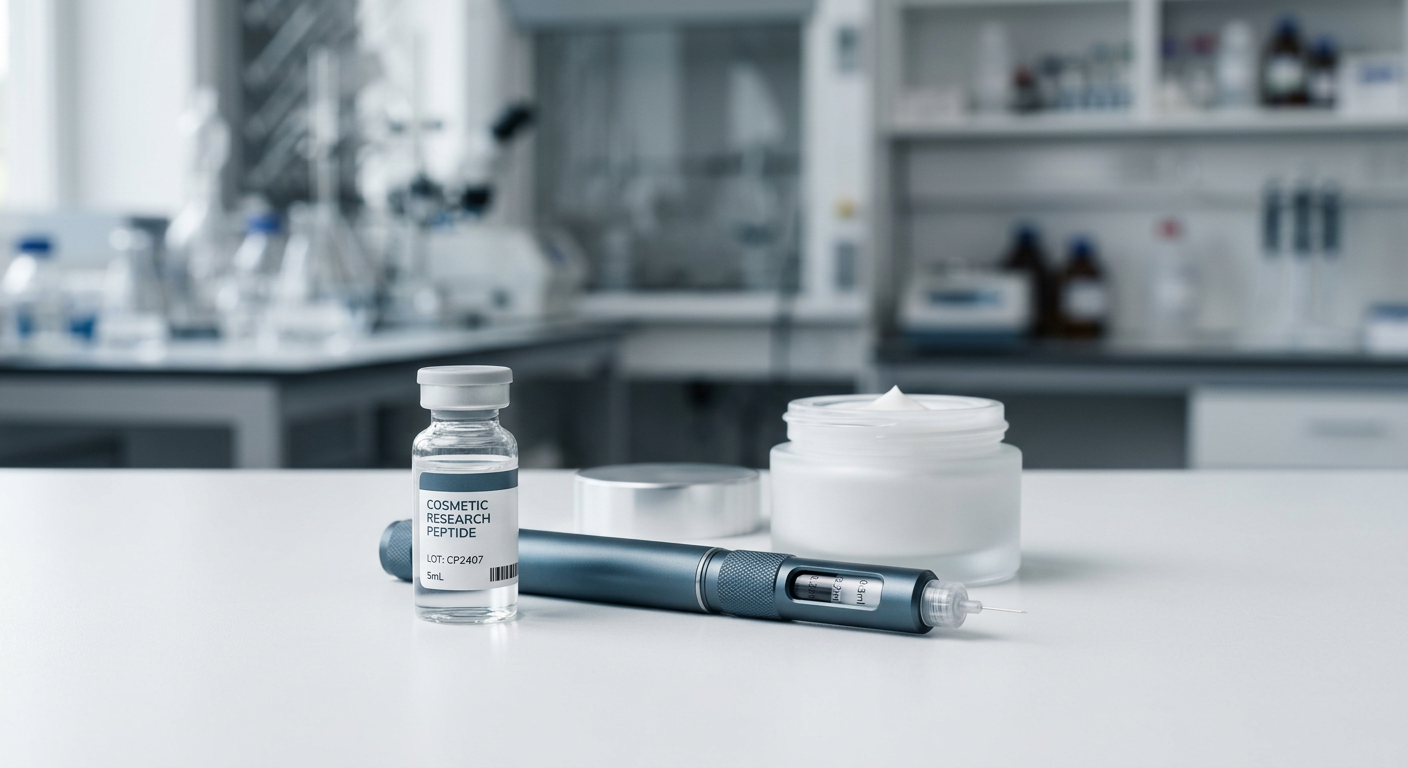
The phrase "glow pen for skin" means completely different things depending on who is using it. In consumer beauty, it refers to a motorised microneedling device — a handheld tool that creates micro-channels in the skin to stimulate collagen and elastin production through controlled wound response. In a laboratory setting, the same phrase maps to something more precise: pre-filled peptide delivery systems used for controlled administration of cosmetic research compounds, most commonly GHK-Cu. These are not beauty gadgets. They are research tools with purity requirements, storage protocols, and documentation chains attached to them.
The problem is that consumer marketing and preclinical research use overlapping language, and that creates real sourcing confusion. Procurement teams end up comparing categories that should not be compared, and researchers end up ordering the wrong product class entirely. This article covers what cosmetic peptides are actually studied for in skin biology research, how delivery formats affect experimental design, what the preclinical evidence genuinely shows, and what sourcing standards any serious laboratory should hold suppliers to.
What "Glow Pen for Skin" Actually Means in a Research Setting
Consumer microneedling devices, including widely used formats such as the Dermapen, work through collagen induction therapy: the needles create micro-injuries, the skin interprets these as damage, and the repair response increases collagen and elastin production. The devices vary in needle depth from 0.25 mm for superficial texture work up to 2.0 mm or more for atrophic scar treatment, with needle depth and cartridge compatibility being key variables that affect outcomes. That is a well-defined product category with a specific mechanism, distinct from what the phrase signifies in a laboratory context.
In a research context, a glow pen for skin refers to something else entirely. A peptide pen kit is a pre-filled delivery system designed for precise, controlled administration of a cosmetic research compound, commonly GHK-Cu, though other peptides are also supplied in this format, at a verified concentration and purity. These kits are not intended for consumer use. They exist to give researchers a reproducible delivery format with documented batch identity, which is the foundational requirement for any data worth publishing.
Procurement teams need to make this distinction clearly before raising a purchase order. Consumer microneedling devices typically do not provide batch-specific Certificates of Analysis or analytical purity data. A research-grade peptide pen kit, by contrast, should include a CoA, purity data, and full batch-specific documentation as standard. Getting the category wrong from the start does not just waste budget — it invalidates the experimental design before the first sample is prepared.
Cosmetic Peptides Most Studied for Skin-Related Research Endpoints
GHK-Cu (glycine-histidine-lysine copper complex) carries the strongest preclinical evidence base in this category by some distance. Cell culture studies have shown fibroblast proliferation, upregulation of collagen I and III synthesis, modulation of matrix metalloproteinases, and changes in glycosaminoglycan expression at nanomolar concentrations. Animal wound-healing models have reported faster tissue repair, improved wound contraction, and better skin-graft integration compared to controls. Replication across independent laboratories gives GHK-Cu a level of preclinical credibility that most cosmetic peptides do not have.
Other compounds appear in dermatology research with reasonable but thinner evidence. Palmitoyl pentapeptide-4 (Matrixyl) has small clinical studies showing modest wrinkle reduction and some preclinical data supporting extracellular matrix signalling, though most of the mechanistic work originates from manufacturer-commissioned studies rather than independent academic replication. Acetyl hexapeptide-3 (Argireline) targets expression wrinkles through proposed neuromuscular modulation, but the human evidence is limited and less consistent than for Matrixyl. BPC-157 appears in wound-healing models but is more commonly associated with musculoskeletal repair research than skin biology specifically.
Selecting the right compound starts with matching the peptide mechanism to the research question. Each compound has a different stability profile, reconstitution requirement, and documentation standard — specification mismatches at this stage routinely result in ordering a compound whose purity grade or carrier format is incompatible with the assay method, which forces reordering and delays the protocol.
Delivery Format Comparison: Injection Pen Kits vs Topical Carriers
Topical peptide formulations deliver compound to the skin surface and rely on passive diffusion across the stratum corneum. Bioavailability is low to variable, constrained by molecular weight, lipophilicity, and the barrier properties of intact skin. Carrier systems such as liposomes can improve penetration, but topical delivery is fundamentally designed for localised surface action, not deep dermal tissue concentrations.
Pre-filled injection pen kits bypass the stratum corneum entirely. The peptide is delivered directly into the dermal layer at a controlled dose, with considerably higher local bioavailability than topical application can achieve. For research purposes, this is not a minor procedural difference — it changes what the experiment is actually measuring. A study using injectable GHK-Cu and a study using topical GHK-Cu cream are not studying the same thing, even if the compound is identical.
Choosing the Right Format: Delivery Route as an Experimental Variable
Delivery route is an experimental variable, not a convenience choice.
When procurement teams are selecting a format for a study protocol, this distinction must be resolved before ordering. Comparative bioavailability data consistently shows that injectable systems achieve substantially higher local tissue concentrations than topical carriers, meaning results from one model cannot be extrapolated to the other without independent supporting evidence. Getting the format right at the sourcing stage protects the integrity of the data.
What the Preclinical Evidence Actually Shows, and Where It Stops
The in vitro data for GHK-Cu is consistent and replicated. Fibroblast cultures show increased collagen synthesis starting at concentrations as low as 10 nanomolar (10⁻⁹ M). Studies describe upregulation of collagen I and III, elastin, and fibronectin, alongside MMP and TIMP modulation that supports matrix remodelling rather than simple accumulation. Keratinocyte proliferation data from skin-equivalent systems adds another layer of supportive evidence.
Animal model findings support faster wound closure, better wound contraction, and increased angiogenesis, consistent with a remodelling-signal mechanism rather than a purely cosmetic one. The limitation is the translation gap: in vitro conditions are idealised, animal skin differs from human dermis in structure and repair kinetics, and no large randomised controlled trials have established clinical efficacy endpoints for cosmetic peptides by pharmaceutical standards.
Researchers should frame their protocols accordingly. These are investigational compounds for laboratory use. That framing is not a weakness in the research programme — it is what separates rigorous science from marketing copy. The evidence supports continued investigation, and well-designed protocols will strengthen the evidence base over time.
Safe Handling, Storage and Laboratory Protocols for Peptide Pen Kits
Lyophilised GHK-Cu and related cosmetic peptides require cold-chain storage. Long-term storage is typically at -20°C in a sealed, dry, light-protected environment, with stability data from suppliers commonly indicating a 12 to 24-month shelf life under these conditions. Short-term storage at 2 to 8°C is acceptable for sealed, unopened vials, but it should not be treated as equivalent to frozen storage for extended periods. Room temperature is not an acceptable option: peptide degradation accelerates within days to weeks at ambient conditions.
Reconstitution should use bacteriostatic water or sterile saline at the volume specified in the product datasheet, prepared in a clean laboratory environment. Once reconstituted, solutions should be stored at 2 to 8°C and used within 14 to 35 days depending on supplier guidance and formulation. Repeated freeze-thaw cycles degrade peptide integrity rapidly.
Prepare single-use aliquots where practical to protect compound quality across the duration of an experiment.
All reconstituted solutions must be clearly labelled with compound name, concentration, preparation date, batch number, and "for research use only" designation. Sharing pen kits between researchers or using a single cartridge across multiple subjects introduces contamination risk and breaks the chain of batch traceability, which undermines the CoA documentation entirely.
A Practical Sourcing Checklist for Research Procurement Teams
Before placing an order for any cosmetic peptide pen kit, procurement teams should confirm the following from the supplier for the specific batch being ordered:
- —Batch-specific CoA with purity result — a minimum of ≥98% is generally accepted as a practical threshold, with ≥99% preferred for high-sensitivity applications
- —HPLC chromatogram with analytical method clearly stated, confirming compound identity
- —Mass spectrometry verification of molecular weight
- —"For research use only" designation on all product documentation
- —Transparent chain of custody from synthesis to dispatch
Any supplier that cannot provide all five elements for the specific batch being ordered should not be used for laboratory procurement. Generic CoA documents that do not match the lot number received, or purity claims without supporting chromatographic evidence, do not meet the standard. The documentation exists to protect research integrity and to protect the procurement team if the sourcing decision is ever audited.
Synedica supplies GHK-Cu pen kits and a range of cosmetic research peptides with documented purity data, including HPLC and mass spectrometry results, and provides a Certificate of Analysis and product datasheet with each order. UK-based procurement teams are encouraged to request batch-specific documentation and handling guidance directly before placing an order, to verify that the supplier’s standards meet the requirements of their specific protocol.
Synedica GLOW GHK-Cu 70mg Pen Kit
Pre-filled cosmetic research peptide delivery system with batch-specific CoA, HPLC and mass spectrometry data. For research use only.
Conclusion: Choosing a Glow Pen for Skin for Research Protocols
Consumer microneedling devices and research-grade cosmetic peptide pen kits share a vocabulary but belong to entirely different product categories. For laboratory teams, the distinction determines what you order, how you store it, what documentation you require, and how you interpret your results. Confusing the two is not a minor sourcing error — it is a problem that runs through the entire experimental design.
GHK-Cu and related cosmetic peptides have a legitimate and growing preclinical evidence base. The compounds are worth studying. The quality of the data, however, depends entirely on the quality of the source material, the delivery format, and the handling protocols used throughout the experiment. Prioritise supplier documentation and verify purity independently. Match delivery format to your research question before the first order is raised — that single decision protects everything that follows.