
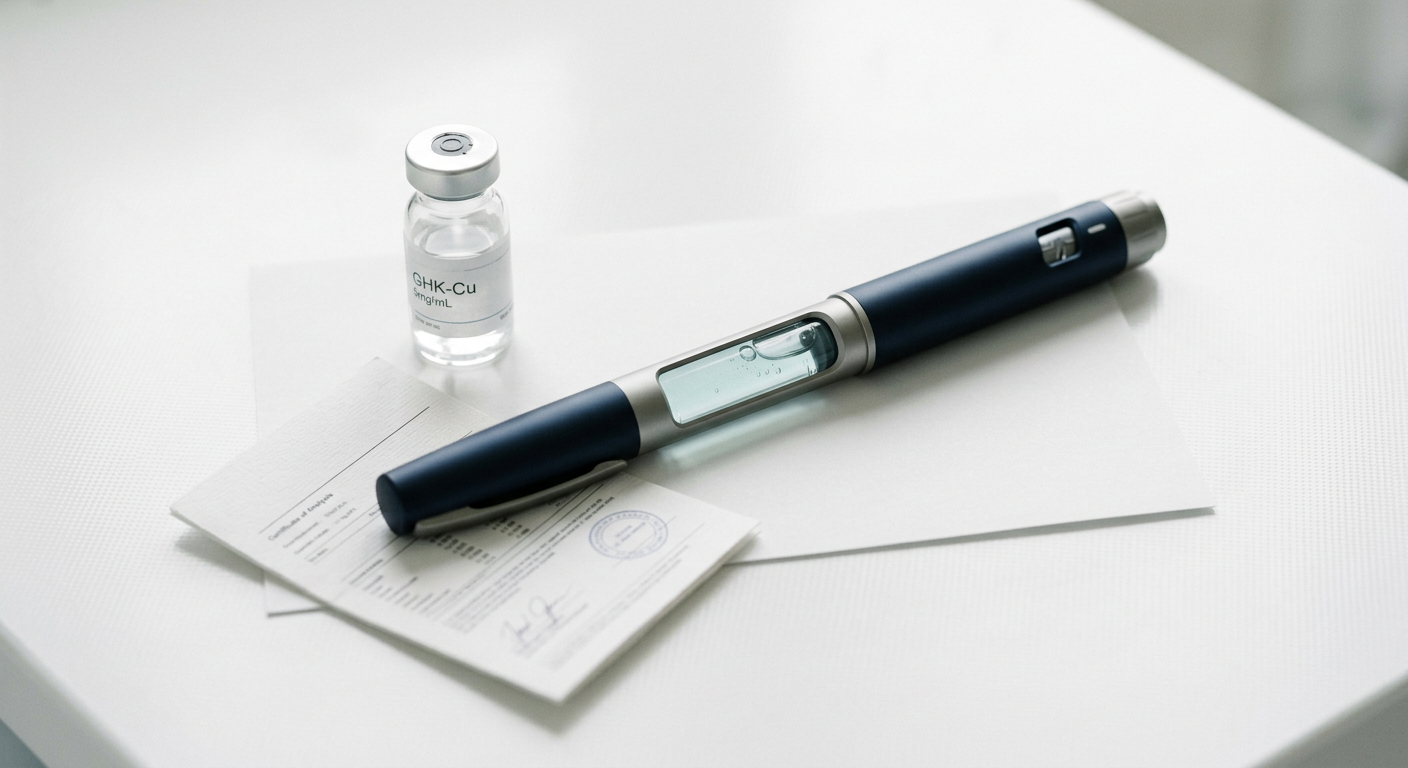
Peptide research is moving away from loose vials and toward pre-filled, pen-format presentations. In the cosmetic peptide field, one term is now common in supplier catalogues and search results: the "glow pen peptide."
For researchers, a pen format offers clear benefits. It can improve dosing consistency, reduce handling steps and standardise how material moves from storage to experiment. It also raises questions that a vial never did. How stable is a peptide once it sits in a cartridge for weeks? Does the container interact with the active ingredient? How do you confirm that the tenth dose matches the first?
This article defines the term for a research audience, explains how pen-format delivery is used in cosmetic peptide studies, and reviews the most common actives. It also covers the specific formulation and stability challenges of pre-filled pens, experimental design, safe laboratory handling, and how to read a Certificate of Analysis (CoA) properly.
What is a "glow pen peptide"?
"Glow pen peptide" is a commercial term, not a scientific one. It combines two ideas: "glow" refers to peptides studied for skin quality outcomes such as radiance, firmness, elasticity and repair, the best known being GHK-Cu, the copper-binding tripeptide. "Pen" refers to the delivery format — a pre-filled device that dispenses measured volumes of a peptide solution.
In practice, the term covers two quite different formats:
- —Multi-dose injection pen kits — cartridge-based pens, similar in design to those used for pharmaceutical peptides, that use a dial mechanism to deliver set volumes through a disposable needle; in research, they are used for dose standardisation in preclinical and analytical work
- —Topical applicator pens — click or twist pens that dispense a serum or gel onto the skin, common in cosmetic formulation research and consumer-use testing
The two formats have very different requirements for sterility, formulation and quality control. Always state which format you are studying.
Why pen-format delivery is used in peptide research
Researchers choose pen formats for practical reasons:
- —Dosing consistency — a calibrated dial mechanism reduces the variability of drawing small volumes from vials with syringes, especially at microlitre scale
- —Fewer handling steps — pre-filled cartridges remove the need for repeated reconstitution, which lowers the risk of contamination and pipetting error
- —Standardised presentation — all study arms can receive material from the same lot, in the same container, prepared the same way
- —Formulation research in its own right — the pen itself is a subject of study, including in-use stability, container–closure compatibility and dose-delivery accuracy
These benefits only hold if the formulation inside the pen is stable and properly characterised. A pen that dispenses precise volumes of a degraded peptide gives precise but meaningless results.
Common actives in glow pen formats
GHK-Cu (copper tripeptide-1)
GHK-Cu is the core active in most glow pen products. It is a naturally occurring tripeptide (glycine–histidine–lysine) bound to copper(II) that has been studied for decades for its role in wound healing and tissue remodelling.
In vitro, GHK-Cu has been reported to stimulate collagen, elastin and glycosaminoglycan synthesis in fibroblasts. It also modulates matrix metalloproteinases and their inhibitors, and shows antioxidant and anti-inflammatory activity. Animal models support its role in wound repair; human data come mainly from small, short topical studies.
Pen-relevant properties: GHK-Cu is small, highly water-soluble and gives solutions a characteristic blue colour. Its copper complex is sensitive to pH, chelating agents and some redox-active ingredients, which makes formulation choices especially important in a liquid, pre-filled format.
Palmitoyl peptides
Palmitoyl peptides are cosmetic peptides with a fatty acid (palmitic acid) attached to improve skin penetration. The main examples are:
- —Palmitoyl pentapeptide-4 (Pal-KTTKS, known as Matrixyl®) — studied for collagen stimulation, with supportive topical human data
- —Palmitoyl tripeptide-1 (Pal-GHK) — a lipidated form of the GHK sequence
- —Palmitoyl tetrapeptide-7 — studied for its effects on inflammatory signalling
Pen-relevant properties: the palmitoyl group makes these peptides lipophilic and poorly soluble in water, so they are well suited to topical applicator pens (serums, emulsions, gels) but hard to formulate as clear aqueous solutions for injection-style cartridges. If a product claims to combine palmitoyl peptides in an aqueous injection pen, ask how solubility and physical stability were achieved and verified.
Multi-peptide "glow" blends
Some glow products combine GHK-Cu with other research peptides, such as BPC-157 and TB-500. Each additional component adds its own stability profile, degradation pathways and analytical requirements, and in a single cartridge the components can also interact with each other. Blends require component-by-component analytical verification. BPC-157 and TB-500 are not approved medicines, and both appear on the World Anti-Doping Agency Prohibited List.
Formulation and stability challenges of pre-filled pens
A peptide stored as a lyophilised powder at −20°C is relatively stable. The same peptide stored as a solution in a cartridge for weeks is not. Pre-filled pens introduce several challenges researchers need to understand.
1. Solution-state degradation
Peptides degrade faster in solution. The main pathways are hydrolysis of peptide bonds (faster at pH extremes), oxidation of histidine, methionine and tryptophan residues (driven by dissolved oxygen, light and trace metals), deamidation of asparagine and glutamine residues in some sequences, and aggregation, which can reduce activity and generate particulates.
For GHK-Cu, the added risk is dissociation of the copper complex, which alters the chemical identity of the active and may change its biological behaviour.
2. pH and buffer selection
The GHK-Cu complex is most stable at roughly neutral to mildly acidic pH (about 5–7). Buffer choice matters — some buffers interact with metal ions, and copper can form poorly soluble salts with certain anions. Strong chelators such as EDTA, often added to formulations for stability, can strip copper from the peptide and should be avoided or justified.
3. Preservatives in multi-dose pens
A multi-dose cartridge is punctured repeatedly, so it normally contains an antimicrobial preservative, such as m-cresol, phenol or benzyl alcohol. Preservatives can:
- —Interact with peptides and promote aggregation in some systems
- —Lose effectiveness through adsorption into the rubber components of the cartridge
- —Interfere with some bioassays, which matters when pen material is used in cell culture
The preservative identity and concentration should be documented and considered in study design.
4. Container–closure interactions
Pen cartridges are usually made of glass with rubber plungers and septa, and are sometimes lubricated with silicone oil. Known issues include:
- —Adsorption of peptide to glass or rubber surfaces, especially relevant at low concentrations
- —Leachables and extractables from rubber components entering the solution
- —Silicone oil droplets, which can be counted as particles and may promote protein or peptide aggregation
- —Metal interactions, since metal ions leaching from components could affect a copper-dependent complex like GHK-Cu
5. Temperature and light
Most pre-filled peptide pens need refrigerated storage (2–8°C) before and during use, with protection from light. Freezing a filled cartridge can damage both the solution (through aggregation and pH shifts during freezing) and the device. Temperature excursions during shipping and storage should be recorded.
6. In-use stability
Once a pen is first used, the clock starts. In-use stability covers how long the product stays within specification after the first puncture, under realistic storage and handling. A stability claim based only on unopened cartridges does not cover the in-use period.
7. Dose-delivery accuracy
The mechanical performance of the pen is part of product quality. Dose accuracy can drift because of air bubbles, plunger friction, needle priming or partial blockage. Pharmaceutical pen injectors are assessed against standards such as ISO 11608. Research users should at least verify delivered volumes gravimetrically.
Experimental design for pen-format peptide studies
Good design turns a convenient format into reproducible data.
Define the question and the format
State clearly whether you are studying the active (using the pen only as a delivery tool), the formulation (stability and compatibility), or the device (delivery accuracy and usability). Each needs different controls and endpoints.
Verify what the pen delivers
- —Gravimetric dose checks — dispense and weigh multiple doses across the life of the cartridge, including the first, middle and last doses
- —Assay of delivered doses — collect dispensed volumes and quantify peptide concentration by HPLC to confirm concentration stays consistent throughout the cartridge
- —Priming procedure — standardise and document how pens are primed before the first dose and between doses
Build a stability-indicating programme
- —Use a stability-indicating HPLC method, validated to separate the intact peptide from its degradation products
- —Test at defined time points under real storage conditions (2–8°C) and under accelerated conditions (for example 25°C)
- —Include in-use simulation — puncture, dispense and return to storage on a schedule that mirrors the study protocol
- —Track purity, assay (concentration), pH, appearance, particulates and, for GHK-Cu, copper content
Include appropriate controls
- —Vehicle control — the same formulation without the peptide, dispensed from an identical pen, since preservatives and excipients can have their own biological effects
- —Freshly prepared reference — a freshly reconstituted solution from lyophilised material of the same lot, for comparison against pen-stored material
- —For GHK-Cu — free copper at an equimolar concentration and GHK without copper, to separate peptide, metal and complex effects
Match biological endpoints to the claim
For skin-related research: procollagen type I ELISA, COL1A1/COL3A1 expression, MMP zymography, migration assays, 3D skin equivalents and ex vivo skin explants. Always run viability assays in parallel, since both free copper and preservatives can be cytotoxic at higher concentrations.
Randomise, blind and document
Randomise the allocation of pens and lots across study arms, blind the analysis where possible, and record lot numbers, pen IDs, first-use dates and storage history for every sample.
Safe laboratory handling of peptide pens
Pen-format peptides are laboratory reagents supplied for research use only. They are not for human or veterinary use, and not for self-administration. Any in vivo work must take place under approved institutional animal care and ethics protocols.
- —Personal protective equipment — wear gloves, a lab coat and eye protection when handling pens, cartridges and dispensed material
- —Sharps safety — use a new needle for every dispensing event, never recap needles by hand, and dispose of them immediately in approved sharps containers
- —No cross-use — assign each pen to a single study or experimental arm; never move needles or cartridges between pens
- —Aseptic technique — clean the cartridge septum before attaching a needle, and work in a biosafety cabinet when the material is destined for cell culture
- —Cold-chain control — store pens at 2–8°C, away from light, and do not freeze them; log temperatures and record any excursions
- —Labelling — label each pen with its study ID, lot number and first-use date, and discard pens at the end of their validated in-use period, even if material remains
- —SDS and waste — review the safety data sheet for each active and excipient, and dispose of copper-containing and preservative-containing waste according to institutional and local rules
What to look for in a Certificate of Analysis
A Certificate of Analysis is the key document for reproducibility. For pen-format products, it should cover both the peptide and the finished, filled product.
Core identity and purity data
- —HPLC purity — the percentage peak area of the main peptide peak; look for the actual chromatogram, not just a number, along with basic method details (column type, detection wavelength, gradient)
- —Mass spectrometry identity — the observed mass should match the theoretical mass of the peptide; for GHK (about 340.4 g/mol), the free peptide appears near m/z 341 as [M+H]⁺, and copper-containing species show a characteristic ⁶³Cu/⁶⁵Cu isotope pattern; for blends, each component should be identified separately
- —Net peptide content or assay — chromatographic purity is not the same as the amount of peptide present, so for solutions the CoA should state the concentration per mL
Finished-product tests specific to pens
- —Fill volume and concentration, so you can calculate the amount per dose
- —pH of the solution
- —Sterility and bacterial endotoxin (LAL) results, essential for any cell or in vivo work
- —Particulate matter (visible and sub-visible)
- —Preservative identity and content, for multi-dose pens
- —Copper content for GHK-Cu products (for example by ICP-MS)
Signs of a trustworthy CoA
- —The lot number on the CoA matches the lot on the product
- —It names the testing laboratory and states whether testing was independent (third-party), ideally at an accredited laboratory
- —It includes test dates that make sense relative to the manufacturing date
- —It shows raw data (chromatograms, mass spectra), not only summary values
Red flags
- —A generic CoA that is not tied to a specific lot
- —Identical purity values (for example "99.9%") across many different batches
- —No chromatogram or mass spectrum
- —No laboratory name, contact details or test date
- —Documents that look edited, or that the supplier will not let you verify
Choosing a supplier for pen-format research peptides
Supplier quality decides whether pen-format studies are reproducible. When evaluating a source, look for high purity, lot-specific and independently verified CoAs, full HPLC and MS data, clear storage and in-use guidance, and a way to authenticate the product. Authentication matters more and more, as counterfeit peptide products circulate in several markets.
Synedica supplies research-grade peptides, including GHK-Cu, at 99% purity and supports them with CoA verification. Purity, identity and potency are confirmed by HPLC and mass spectrometry. Synedica also offers ready-to-use injection pen kits for research and development, which give laboratories a standardised, pre-filled format that reduces reconstitution steps and handling variability. Each product can be checked against Synedica's verification system, and batch documentation is available to support audits and reproducible studies.
Synedica GLOW GHK-Cu 70mg
Research-grade copper tripeptide, independently tested with batch-specific HPLC and mass spectrometry data. For research use only.
Frequently asked questions
What is a glow pen peptide?
It is a commercial term for a skin-focused peptide, most often GHK-Cu, supplied in a pre-filled pen format. The format may be a multi-dose injection pen kit or a topical applicator pen.
Are glow pens more stable than vials?
Not necessarily. Lyophilised peptides in vials are usually more stable than peptides in solution. Pens offer convenience and dosing consistency, but they need careful formulation, refrigerated storage and a defined in-use period.
Can palmitoyl peptides be used in injection pens?
Palmitoyl peptides are lipophilic and poorly water-soluble, so they are better suited to topical applicator formats. Aqueous injection-style formulations containing them need clear evidence of solubility and physical stability.
How should research peptide pens be stored?
Typically at 2–8°C, protected from light, and never frozen. Discard them at the end of the validated in-use period.
What should a CoA for a peptide pen include?
HPLC purity with chromatogram, MS identity, concentration per mL, pH, sterility, endotoxin, particulates and preservative content. For GHK-Cu, it should also include copper content. The lot number should match the product.
This article is for informational and research purposes only. Synedica products are supplied for laboratory research use and are not intended for human or veterinary use.