
"Glow peptide" is not a scientific term. You will not find it in a pharmacopoeia or a peer-reviewed nomenclature. It is a market label that has spread quickly through cosmetic, aesthetic and research-supply channels. For scientists, procurement teams and formulators, the label raises questions. Which molecule is actually being discussed? What does the evidence really show? How do you run studies whose results you can trust?
This guide answers those questions. It covers what the term usually refers to, the leading cosmetic peptide candidates, their proposed mechanisms in skin and hair biology, the strength of the current evidence, and the practical details that decide whether a study is reproducible: experimental design, formulation stability, analytical verification and safe laboratory handling.
What is a "glow peptide"?
In most research and cosmetic contexts, "glow peptide" refers primarily to GHK-Cu (glycyl-L-histidyl-L-lysine copper(II)), a naturally occurring copper-binding tripeptide. The name reflects the outcomes most often studied in relation to it: skin radiance, firmness, texture and repair.
The term is also used more loosely, in three ways:
- —GHK-Cu alone, the most common and best-characterised meaning
- —Multi-peptide "GLOW" blends, typically GHK-Cu combined with BPC-157 and TB-500 (a synthetic fragment related to thymosin beta-4)
- —Compounded antioxidant preparations, in which GHK-Cu is combined with non-peptide ingredients such as glutathione and ascorbic acid
For a research protocol, this ambiguity matters. A study of a three-peptide blend cannot be interpreted like a study of GHK-Cu alone. Its components have different mechanisms, different evidence bases and different analytical requirements.
The first rule of glow-peptide research is to define exactly which molecule, or which combination, you are studying.
The leading cosmetic peptide candidates
GHK-Cu dominates the "glow" conversation, but it sits within a broader class of cosmetic peptides. Researchers usually group these peptides by their proposed mode of action:
- —GHK-Cu (copper tripeptide-1) — carrier/signal peptide; copper delivery and extracellular matrix synthesis; extensive in vitro and animal data with small human cosmetic studies
- —Palmitoyl pentapeptide-4 (Pal-KTTKS, Matrixyl®) — signal peptide; stimulates collagen and matrix synthesis; supported by randomised, controlled human topical studies
- —Acetyl hexapeptide-3/-8 (Argireline®) — interferes with SNARE complex formation; reduces expression-line depth; in vitro plus small human studies
- —Palmitoyl tripeptide-1 (Pal-GHK) — lipidated GHK with improved lipophilicity; mainly formulation and in vitro data
- —Palmitoyl tetrapeptide-7 — reported reduction of inflammatory cytokine signalling (e.g. IL-6); mainly in vitro and industry data
- —BPC-157 / TB-500 (in blends) — proposed angiogenic and tissue-repair signalling; predominantly preclinical and not approved for any human use
For skin and hair regeneration specifically, GHK-Cu has the longest research history and the most diverse mechanistic literature. It is therefore the focus of the rest of this article.
GHK-Cu: background and biology
GHK was first isolated from human plasma by Loren Pickart in 1973. It was identified as a factor in young plasma that altered the behaviour of liver tissue from older donors. GHK binds copper(II) with high affinity, and much of its biological activity is attributed to the copper complex.
Several observations have shaped later research:
- —Age-related decline: plasma GHK levels are reported to fall from roughly 200 ng/mL around age 20 to about 80 ng/mL by age 60, making the peptide a natural candidate in ageing research
- —Matrix origin: the GHK sequence occurs within extracellular matrix proteins, including collagen, leading to the hypothesis that GHK is released during proteolysis at injury sites and acts as an early "damage signal" that promotes repair
- —Copper biology: copper is an essential cofactor for enzymes central to skin structure, notably lysyl oxidase (collagen and elastin cross-linking) and superoxide dismutase (antioxidant defence); GHK may serve as a physiological copper-delivery vehicle
Proposed mechanisms for skin regeneration
The mechanistic literature on GHK-Cu is broad. The mechanisms below are the ones most relevant to skin quality and repair.
- —Extracellular matrix synthesis: in cultured dermal fibroblasts, GHK-Cu has been shown to stimulate synthesis of collagen, glycosaminoglycans and the proteoglycan decorin, often at low nanomolar concentrations
- —Balanced matrix remodelling: GHK-Cu has been reported to modulate matrix metalloproteinases (e.g. MMP-2) and their tissue inhibitors (TIMP-1 and TIMP-2), suggesting a role in regulating turnover rather than simply increasing deposition
- —Antioxidant and anti-inflammatory activity: in macrophage models, GHK-Cu pretreatment has reduced reactive oxygen species, restored superoxide dismutase activity and lowered pro-inflammatory cytokine release
- —Angiogenesis and wound repair: animal studies in rats, mice, rabbits and pigs have reported accelerated wound contraction, improved granulation tissue and better healing of ischaemic wounds
- —Broad gene-expression effects: Connectivity Map analyses suggest GHK can shift expression of many human genes toward a "healthier" profile, including genes involved in remodelling, antioxidant defence and DNA repair — these are hypothesis-generating findings that need validation in relevant tissue models
Proposed mechanisms for hair strengthening
Hair research on copper peptides is less mature but still interesting:
- —Early rodent studies reported that copper peptides could increase hair follicle size and support hair growth
- —In an ex vivo study, a related copper tripeptide (AHK-Cu) stimulated elongation of isolated human hair follicles and proliferation of dermal papilla cells, and reduced markers of apoptosis
- —Proposed mechanisms include better nutrient and blood supply around the follicle (angiogenesis), matrix support in the dermal papilla niche, and anti-inflammatory activity in the scalp
Research priority: most hair data involve either animal models or AHK-Cu rather than GHK-Cu. Direct, controlled comparisons of GHK-Cu in human follicle organ culture and 3D dermal papilla spheroid models remain a clear gap.
Reviewing the evidence: what is established and what is not
A fair reading of the literature separates three tiers.
- —In vitro (strong and consistent): repeated studies show effects on fibroblast matrix synthesis, remodelling enzymes and oxidative stress markers, though concentration ranges, cell-line choice and lack of copper-only controls vary widely between studies
- —In vivo, animal (supportive): wound-healing models in several species support regenerative activity, with some studies reporting systemic effects at sites distant from the injection; species and dosing-route differences limit translation
- —Human (promising but limited): several controlled facial studies of topical GHK-Cu report improvements in laxity, fine lines, density and clarity, but sample sizes are small, durations short (typically 8–12 weeks) and many are industry-sponsored; rigorous independent human data on multi-peptide "GLOW" blends and injectable preparations are essentially absent
Bottom line: GHK-Cu has a credible mechanistic rationale and a long research history. The evidence gap lies in well-controlled, independently replicated studies with standardised, analytically verified material.
Practical guidance for researchers
Experimental design
Many inconsistencies in the peptide literature come from design choices rather than biology. To produce interpretable data:
- —Include the right controls — at minimum a vehicle control, free copper at an equimolar concentration (e.g. CuCl₂), and GHK without copper; a scrambled-sequence peptide further strengthens specificity claims
- —Run full dose–response curves — effects on matrix synthesis are often reported at picomolar to low-micromolar concentrations and some endpoints may be non-monotonic (bell-shaped)
- —Monitor cytotoxicity — free copper becomes cytotoxic at higher concentrations, so run viability assays (MTT, resazurin or LDH release) alongside functional endpoints
- —Choose endpoints that match the claim — procollagen I C-peptide ELISA, Sirius Red staining or COL1A1/COL3A1 qPCR for collagen; gelatin zymography and TIMP ELISA for remodelling; scratch/migration assays or skin equivalents for repair; follicle organ culture for hair
- —Consider delivery — GHK is small and hydrophilic with limited penetration through intact stratum corneum, so use Franz diffusion cells with human or porcine skin and compare delivery strategies such as lipidated analogues, liposomes or microneedle pretreatment
- —Pre-register and blind where possible — blinded image analysis and pre-specified endpoints reduce bias, especially in cosmetic studies with subjective outcomes
Formulation and stability considerations
GHK-Cu is chemically sensitive. Stability failures are a common source of irreproducible results.
- —pH window — the copper complex is most stable at roughly neutral to mildly acidic pH (about 5–7); strongly acidic systems such as high-concentration AHA formulations can destabilise it
- —Chelators — EDTA and other strong chelating agents can strip copper from GHK; avoid them in formulations and buffers or explicitly account for them
- —Redox-active ingredients — L-ascorbic acid can reduce Cu(II) and promote reactive oxygen species generation, so combining it with GHK-Cu needs careful stability testing
- —Peptide degradation — watch for hydrolysis, oxidation of histidine and microbial contamination in aqueous systems, and validate preservative systems for any topical formulation
- —Storage — store lyophilised material cold (typically −20°C), dry and protected from light; after reconstitution, make single-use aliquots to avoid repeated freeze–thaw cycles
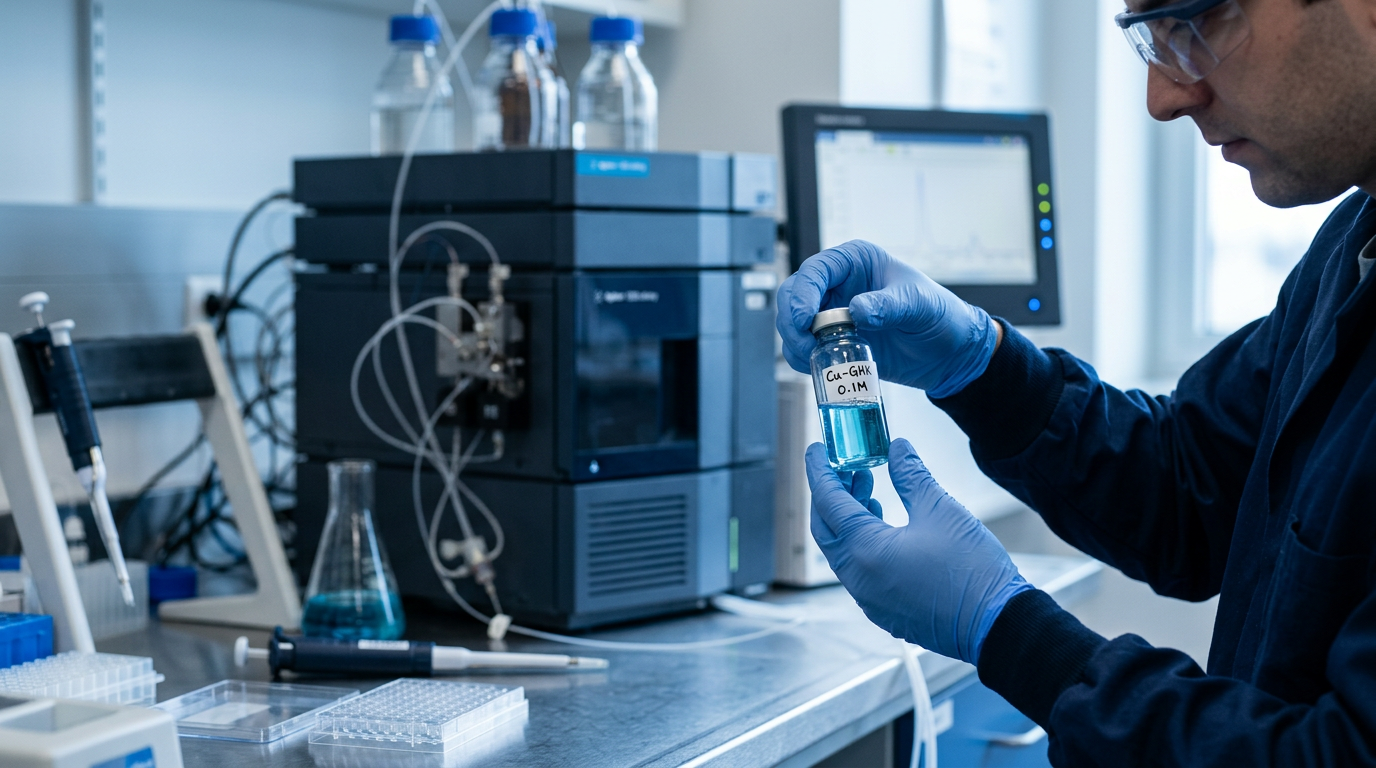
- —Visual check — GHK-Cu solutions are characteristically blue; a colour shift can indicate complex dissociation or contamination, though it never replaces analytical testing
Analytical testing: HPLC and mass spectrometry
Reproducibility starts with knowing exactly what is in the vial. For any peptide study, analytical verification should confirm identity, purity and quantity.
HPLC (purity): reversed-phase HPLC (C18) with UV detection at 214–220 nm is the standard purity method for peptides. GHK is small and very polar, so it can retain poorly on conventional C18 columns — ion-pairing agents (e.g. TFA or HFBA) or HILIC methods can improve retention and resolution. Report purity as the percentage peak area of the main peak, noting that chromatographic purity is not the same as net peptide content.
Mass spectrometry (identity): LC-MS confirms molecular identity. GHK has a molecular weight of about 340.4 g/mol, so the free peptide appears near m/z 341 as [M+H]⁺. Copper-containing species show a characteristic ⁶³Cu/⁶⁵Cu isotope pattern (about 69:31), a useful fingerprint for confirming the complex. For blends, each component peptide should be identified individually.
Additional tests worth requesting or running:
- —Net peptide content (e.g. by amino acid analysis or nitrogen analysis), since lyophilised peptides contain counter-ions (TFA or acetate) and water
- —Copper content (e.g. ICP-MS) to confirm the peptide-to-copper ratio
- —Endotoxin testing (LAL assay) for any cell-culture or in vivo work
- —Residual TFA, which can itself affect cell behaviour
Why this matters: two batches with the same label can behave very differently if their purity, copper stoichiometry or counter-ion content differ. Without batch-level analytical data, a negative result may mean the peptide is inactive, or that the material was degraded — you cannot tell which.
Safety and handling for laboratory use
Research peptides, including those sold under "glow" labels, should be handled as laboratory reagents:
- —Research use only — research-grade peptides are intended for in vitro and authorised preclinical research, not for human or veterinary use, self-administration or clinical application outside approved and ethically reviewed protocols
- —Personal protective equipment — wear gloves, a lab coat and eye protection, and weigh lyophilised powders in a way that avoids inhaling dust
- —Read the SDS — review the safety data sheet for each compound, including copper-related hazards
- —Aseptic technique — use sterile diluents and aseptic handling for any material destined for cell culture
- —Waste disposal — dispose of copper-containing waste according to institutional and local environmental rules
- —Traceability — record lot numbers, CoA references, reconstitution dates and storage history for every experiment, essential for audits and troubleshooting
- —Regulatory awareness — BPC-157 and TB-500 appear on the World Anti-Doping Agency Prohibited List and are not approved medicines; institutions working with athletes or human-subject research should take this into account
Research priorities: where the field needs to go
The next phase of glow-peptide research should focus on five priorities:
- —Independent, adequately powered human studies of topical GHK-Cu, with objective endpoints such as ultrasound dermal density, profilometry and biopsy-based collagen measures
- —Mechanistic validation of gene-expression findings in primary human cells and 3D skin models
- —Head-to-head comparisons of GHK-Cu with other cosmetic peptides and established actives, such as retinoids, under standardised conditions
- —Delivery science, meaning quantitative penetration studies that compare vehicles, lipidated analogues and physical enhancement methods
- —Rigorous characterisation of multi-peptide blends, including stability, compatibility and component-specific analytics, before any biological claims are made
All five priorities depend on the same foundation: well-characterised starting material.
Sourcing research-grade material: why verification matters
The quality of the input determines the credibility of the output. When sourcing GHK-Cu or other cosmetic peptides for research, look for:
- —A batch-specific Certificate of Analysis (CoA), not a generic product sheet
- —Independent third-party testing, not only internal quality control
- —Both HPLC and mass spectrometry data, confirming purity and identity
- —Clear storage, handling and research-use labelling
- —Product authentication, a growing concern given the counterfeit peptides circulating in some markets
Synedica supplies research-grade cosmetic peptides, including Synedica GLOW GHK-Cu, for laboratory and development use. Every batch is independently tested and supplied with Certificates of Analysis, and purity, identity and potency are verified by HPLC and mass spectrometry. That lets research teams document exactly what went into each experiment and supports reproducible, publishable results. Academic and institutional buyers can request batch documentation before ordering.
Synedica GLOW GHK-Cu 70mg
Research-grade copper tripeptide, independently tested with batch-specific HPLC and mass spectrometry data. For research use only.
Frequently asked questions
Is "glow peptide" the same as GHK-Cu?
Usually, but not always. The term most often refers to GHK-Cu, but it is also used for multi-peptide blends (such as GHK-Cu with BPC-157 and TB-500) and for compounded preparations containing antioxidants. Always confirm the exact composition.
What is the strongest evidence for GHK-Cu?
The most consistent evidence is from in vitro studies showing stimulation of collagen and matrix synthesis and modulation of remodelling enzymes, supported by animal wound-healing models. Human cosmetic studies are encouraging but small.
Does GHK-Cu strengthen hair?
Preclinical data suggest copper peptides can support follicle size and dermal papilla cell activity. Controlled human data on GHK-Cu specifically are limited.
How should GHK-Cu be stored for research?
Store lyophilised material at about −20°C, protected from light and moisture. Aliquot after reconstitution and avoid repeated freeze–thaw cycles.
Which analytical tests should a CoA include?
At minimum, HPLC purity and mass spectrometry identity. For rigorous work, also consider net peptide content, copper content and endotoxin testing.
This article is for informational and research purposes only. Synedica products are supplied for laboratory research use and are not intended for human or veterinary use.